ElevenLabs is the best AI voice provider out there right now, at least in my book.
And yet a lot of people go looking for an alternative. For good reasons.
Sometimes it's the cost, once you start generating serious amounts of audio. Sometimes it's latency, the lag that ruins a voice assistant or phone agent when it has to respond in real time. And sometimes you just have a specific need that a specialized tool handles better.
I looked at the 8 most important ElevenLabs alternatives and wrote down, for each one, who it pays off for and who it doesn't. Here's the short version: ElevenLabs stays the benchmark in most cases. But there are situations where an alternative is the better call.
If you're still on the fence in general, my big roundup of the best AI voice generators will help too.
- OpenAI TTS (gpt-4o-mini-tts) is the obvious alternative if you already work inside the OpenAI ecosystem and want to steer the voice with plain language
- Cartesia (Sonic) is the pick for real-time use with ultra-low latency, such as voice assistants and phone agents
- ElevenLabs stays the best choice for most people because it combines text-to-speech, speech-to-text, music, dubbing, and voice agents in one platform
1. When an ElevenLabs Alternative Makes Sense
Before we get to the tools, one caveat.
You don't need an alternative for every use case. ElevenLabs is the reference standard for AI voices for a reason. The voices sound more natural than almost all competitors, and with Eleven v3 you can steer emotion and emphasis right inside the text using so-called audio tags like [whispers] or [laughs]. Nearly every competitor lets you mark up rate, pauses, and emphasis through SSML, but a stage direction like [laughs] in the middle of a sentence is something no other tool understands.
I cover what that actually feels like day to day in my full ElevenLabs review.
But there are three situations where it's genuinely worth looking beyond it:
- Cost: If you generate very large amounts of audio, usage-based API billing can be cheaper than a fixed subscription.
- Latency: In real-time use cases like voice assistants or phone agents, every millisecond counts. Some specialized tools react even faster here.
- Specific needs: If you only want to read text aloud, or you need very tight integration into an existing ecosystem, a leaner tool is sometimes the better choice.
For everything else, I still reach for ElevenLabs. But let's look at the alternatives in detail.
2. ElevenLabs and the Alternatives Compared
Here's ElevenLabs as the reference plus the 8 alternatives at a glance:
As of August 2026, entry-level prices taken from the pricing page of each provider.
That's why the price column deliberately isn't sortable. A monthly subscription, an annual price, and an API bill per character simply aren't comparable numbers, and sorting them would claim a ranking that doesn't exist.
I can still give you one normalized figure. With ElevenLabs, one character of text-to-speech costs exactly one credit, which I measured four times in my own account. So 10,000 characters of text cost you 10,000 credits there, and that happens to be the exact monthly allowance of the free plan. For Lovo, Murf, Speechify, WellSaid Labs, and Descript that math doesn't work. They sell you a monthly allowance inside a subscription rather than a price per character, and each provider defines what sits inside that allowance differently.
And since a table full of checkmarks still doesn't tell you what to reach for, here's the shortcut. On the left is the reason people ask me for an alternative, on the right the tool that serves exactly that reason best:
The last row isn't a slip. If you want several audio jobs handled in one tool, the best reason to switch is sometimes not to switch at all. You'll see why in section 4.
One thing I need to put on the table first.
3. The 8 ElevenLabs Alternatives in Detail
Below I introduce each alternative one by one, with its strengths and its weaknesses.
3.1 Lovo (Genny)
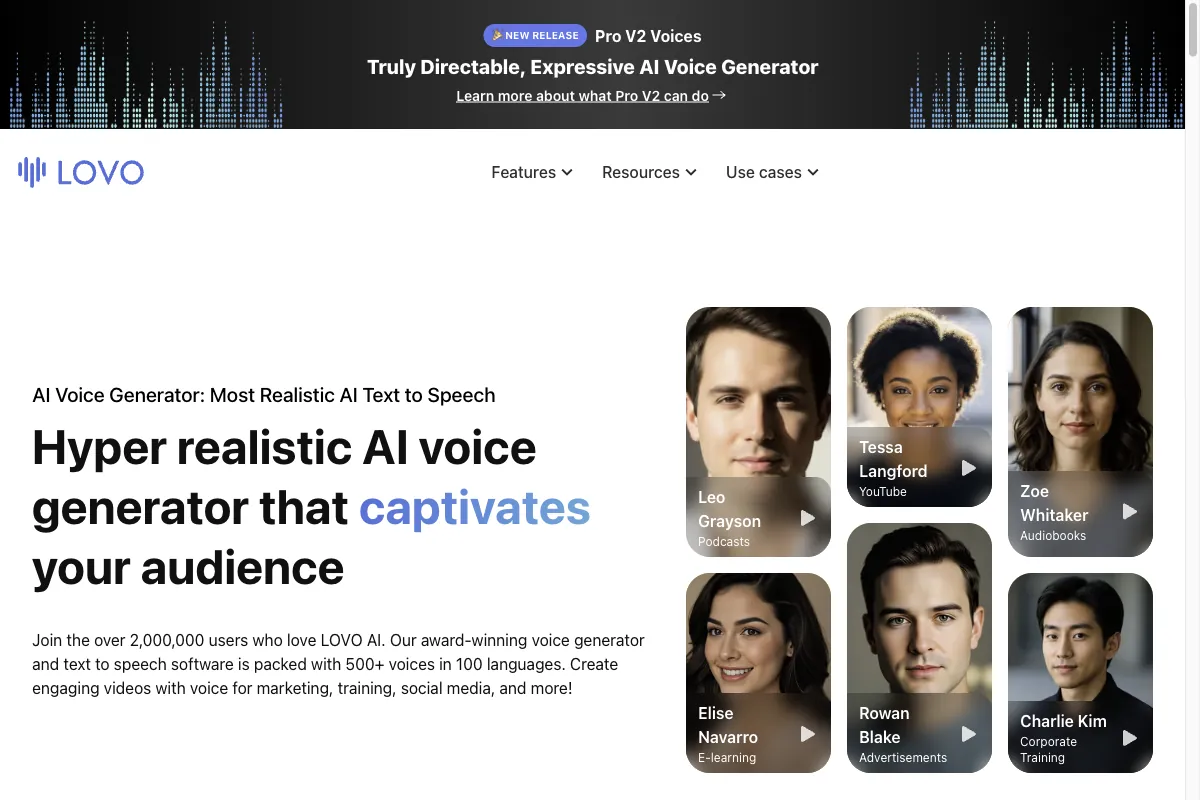
Lovo and its Genny platform are mainly an answer to the question of voice variety. With 500+ voices across more than 100 languages, you have a huge selection. On top of that, there's a built-in editor where you assemble your voiceover into finished content with video, captions, and an AI script assistant.
For creators who want to produce not just audio but short videos as well, that all-in-one approach is handy.
Voice cloning is on board too. About a minute of audio is enough for your own voice.
The catch:
Lovo tries to be a lot of things at once, and you can hear it in the voice quality. The voices sound fine, but to my ear they don't quite reach the naturalness of ElevenLabs. If top voice quality matters more to you than the bundled editor, the difference shows.
Best suited for content creators who want maximum voice variety plus a built-in editor for voiceover and video in one tool.
Not suited for projects where voice quality beats everything else, such as an audiobook or a commercial.
3.2 Murf
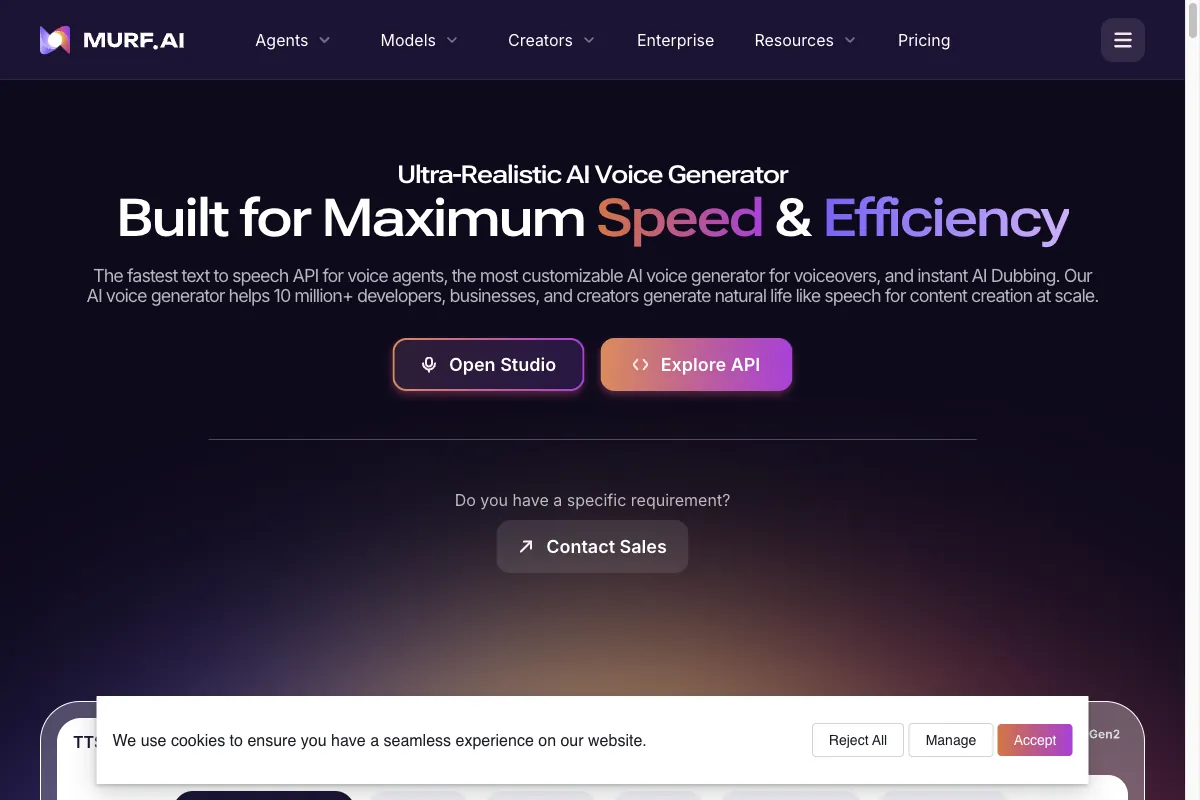
Murf is less a pure voice generator and more a small voiceover suite. Alongside speech output, you get a built-in editor that lets you assemble your voiceover into a finished presentation with images, music, and video.
That's the big plus: you don't have to export your audio into a separate editing program, you do everything in one interface.
For explainer videos, presentations, and e-learning, that's a pleasant workflow.
Don't get me wrong:
Murf does solid work. But to my ear the voices sound less natural than ElevenLabs, and the language selection is smaller. If top voice quality is your most important criterion, you'll notice the difference.
Best suited for anyone who wants to handle voiceover and video editing in one tool, for example for presentations and explainer videos.
Not suited for multilingual projects with many target languages, or for anything that needs maximum naturalness.
3.3 Cartesia (Sonic)
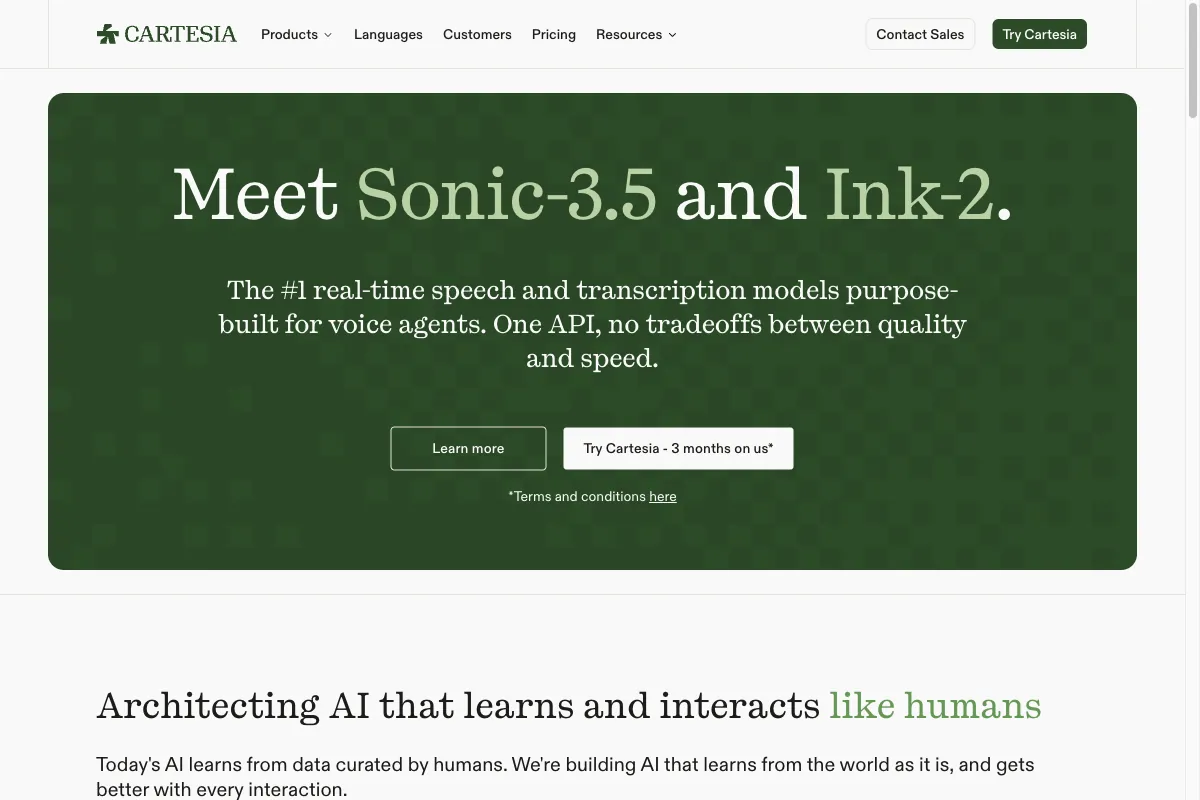
Cartesia with its Sonic model is the most specialized alternative on this list. The entire focus is on a single goal: ultra-low latency.
Latency is the time between your input and the first audible sound. For a pre-produced audiobook, that doesn't matter. For a voice assistant, a phone agent, or live translation, it decides whether a conversation feels natural or clunky.
This is exactly where Cartesia shines. For real-time agents that have to respond live, it's an excellent choice.
The catch:
The portfolio is small. There's no music feature like ElevenLabs Music and no sound effects, and otherwise Cartesia is more of a specialized building block than a complete audio platform. You use it deliberately for the one use case it was built for.
Best suited for developers of voice assistants, phone agents, and other real-time applications where latency is the most important criterion.
Not suited for full content production, where music and sound effects come up alongside speech, or for anyone who would rather work in an interface than an API.
3.4 Resemble AI
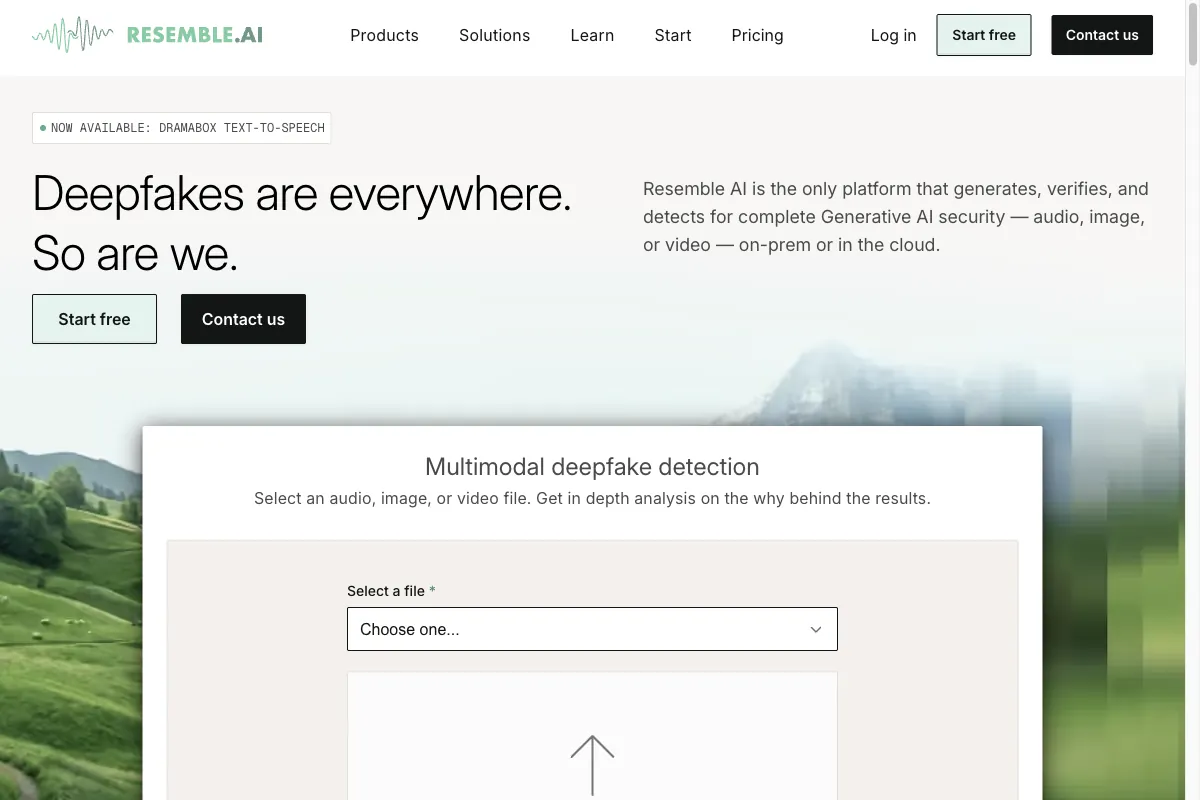
Resemble AI targets companies above all and offers, among other things, real-time voice conversion, meaning turning one voice into another in real time. Voice cloning and enterprise features round it out.
If you work in a larger company with specific demands around security, integration, and support, you'll find a lot of fitting building blocks at Resemble AI.
That said:
The self-serve comfort is lower than with ElevenLabs, and the tool tends to be pricier. For individuals and small teams it's therefore more of an overkill solution. It plays to its strengths when the enterprise context justifies the extra effort.
Best suited for companies with enterprise requirements that need real-time voice conversion and custom integration.
Not suited for individuals and small teams who just need a quick voiceover without starting a procurement process for it.
3.5 Speechify
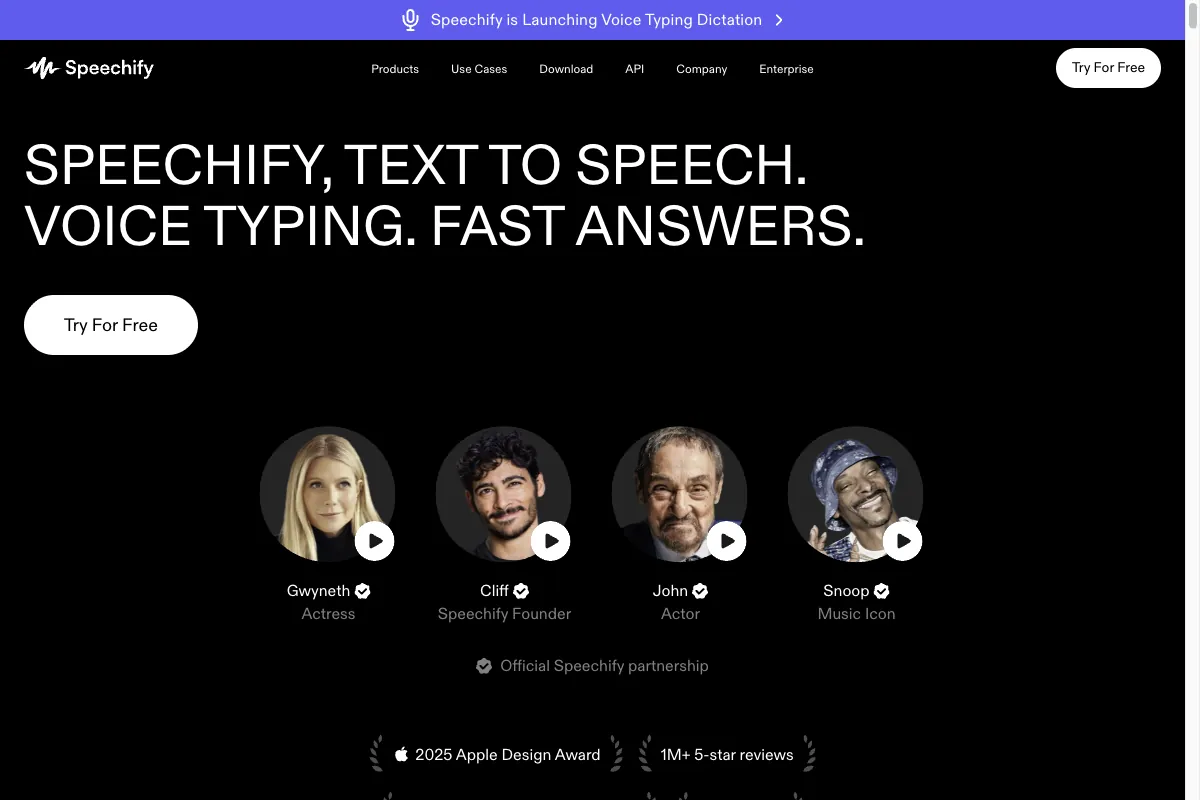
Speechify takes a completely different approach from the other tools. It's first and foremost a reader app for end users that reads web pages, PDFs, e-books, and documents to you. Through apps and browser extensions, you listen to text on the go, at the gym, or in the car.
For exactly that purpose, Speechify is cheap and very convenient. If you read a lot and prefer to consume content rather than produce it yourself, it's a good choice.
The catch:
Speechify is long past being just a reader app, mind you. Speechify Studio is a production side of the house with voice cloning and dubbing, and for companies there are even voice agents, per the Speechify product pages.
The center of gravity is still reading aloud, though, and that's where the product is most polished. If you mainly produce voiceovers, you're paying for a pile of reader features you'll never touch.
Best suited for heavy readers who want to listen to text on the go, from students to professionals with a big reading load.
Not suited for anyone who mainly produces rather than consumes. There are better-fitting tools for that in this comparison.
3.6 WellSaid Labs
WellSaid Labs specializes in high-quality studio voices for professional use. The voices are cleanly produced and work well for e-learning, corporate communication, and training content. The company has been part of Podcastle since 2024, though the product keeps running unchanged at wellsaid.io.
The provider puts a lot of weight on vetted, licensed voices.
And that's also the most important limitation:
You can't freely clone an arbitrary voice the way you can with ElevenLabs. WellSaid Labs deliberately relies on a curated voice portfolio instead of free voice cloning. On top of that, it tends to be pricier. But if the ethical and legal safety of vetted voices matters to you, that's exactly the upside.
Best suited for companies that need vetted studio voices for e-learning and internal communication and can do without free cloning.
Not suited for anyone who wants to clone their own voice on the spot, or for projects on a tight budget.
3.7 Descript
Descript isn't actually a TTS tool, it's an editor for audio and video that lets you edit by editing text. You delete a word in the transcript, and the matching piece of audio disappears with it. The AI voice sits in the Overdub feature, which lets you correct yourself during editing without re-recording the passage.
For podcasters and video creators, that workflow saves a ton of time.
Don't get me wrong:
Descript is an excellent editing tool, and its cloning is full-fledged now rather than a patch-up feature. The voice still isn't the point of the software. If you're after flexible, high-quality voice production, Descript isn't made for that. Its strength lies in editing-focused work.
Best suited for podcasters and video creators who want to edit their content via text and handle small fixes with the Overdub voice.
Not suited for projects where the AI voice is the lead actor rather than the repair kit for a recording.
3.8 OpenAI TTS (gpt-4o-mini-tts)
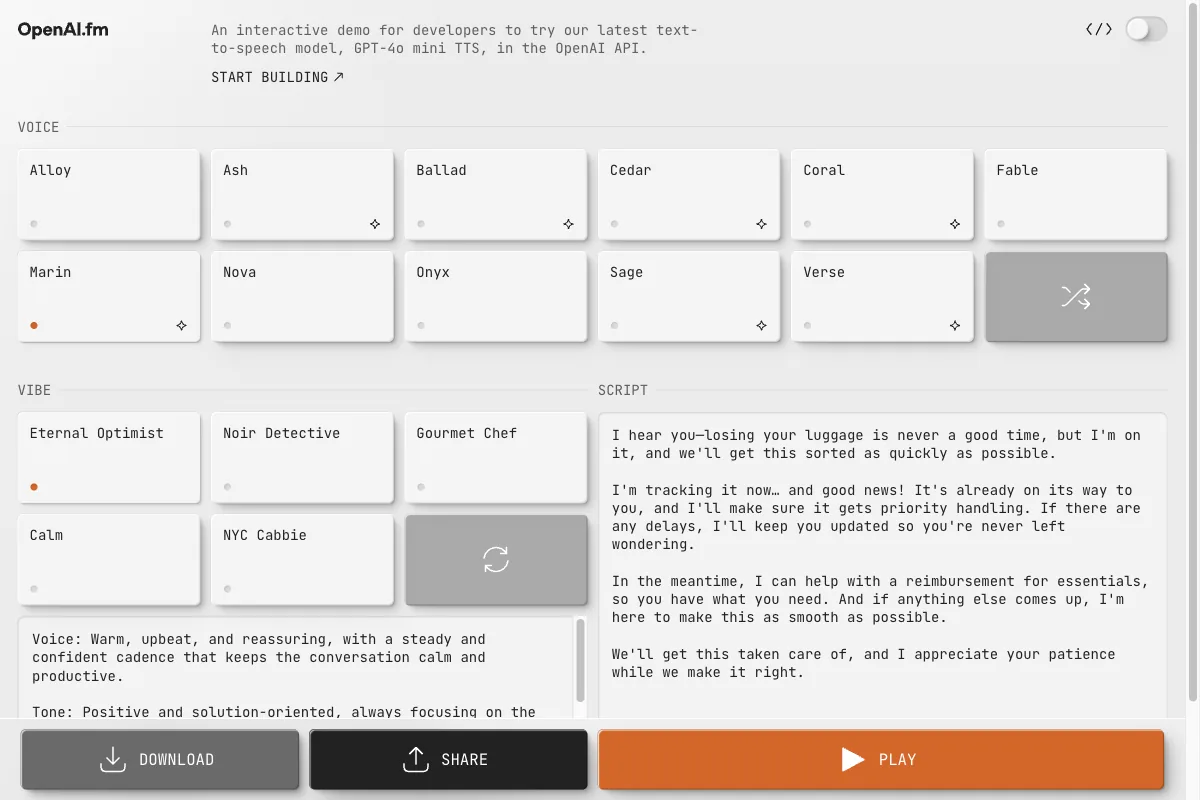
OpenAI TTS is the most obvious alternative if you already work with ChatGPT or the OpenAI API. With the gpt-4o-mini-tts model, you don't pick from a long list of voices. Instead you describe in plain language how the voice should sound, for example calm, friendly, or energetic. For real-time use cases like voice assistants, OpenAI now also offers its Realtime API with the newer gpt-realtime-2 model.
It's an interesting approach, because you steer the output without sliders and menus. You just say what you want.
The big upside is the tight fit into the OpenAI ecosystem. If your app already runs on OpenAI models, you integrate speech output with very little extra effort.
That said:
The selection of fixed voices is limited, there's no voice cloning, and no dubbing. If you want to reproduce a specific voice or auto-sync videos, OpenAI TTS isn't the right tool.
Best suited for developers and teams already working in the OpenAI ecosystem who want simple speech output they can steer with plain language.
Not suited for voice cloning, for dubbing, or for anyone who works without code and needs a finished interface.
4. But in Most Cases, ElevenLabs Stays the Best Choice
I've now shown you 8 alternatives. And every one has its place.
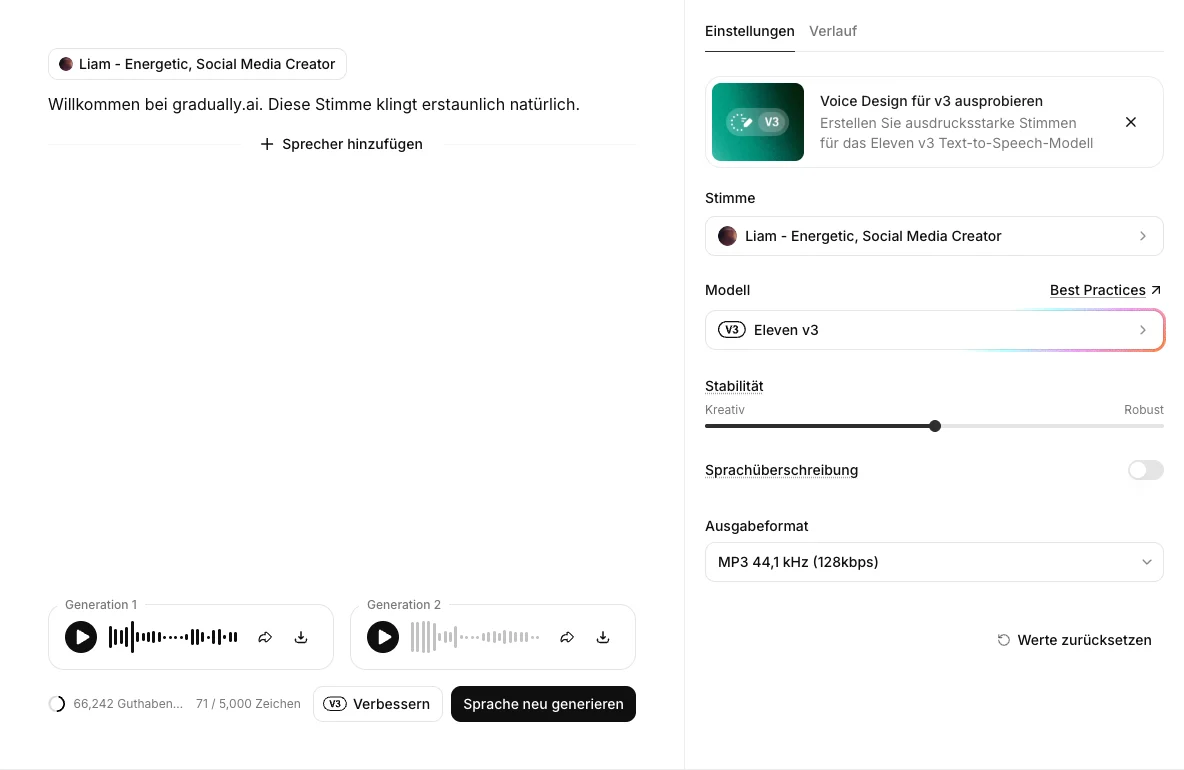
Before I hand down a verdict, I didn't want to just go off memory. For this comparison I logged back into my own ElevenLabs account and went through the current editor and voice library live, the way I test any tool before I recommend it.
Still, I almost always end up back at ElevenLabs. There are two reasons for that.
The first is quality. The voices simply sound more natural than most competitors, and with Eleven v3 you steer emotion and emphasis through audio tags like [whispers] or [laughs] right inside the text. The editor even highlights the tags in color, so you instantly see what the model reads as a stage direction. Nearly every competitor lets you mark up rate, pauses, and emphasis through SSML, and OpenAI TTS lets you describe the delivery in plain language. A [laughs] dropped into the middle of a sentence, though, is something no other tool in this comparison understands.
The second reason is the portfolio. Some of the alternatives have grown broader than I expected, more on that in a moment. The whole chain, though, is still covered by ElevenLabs alone.
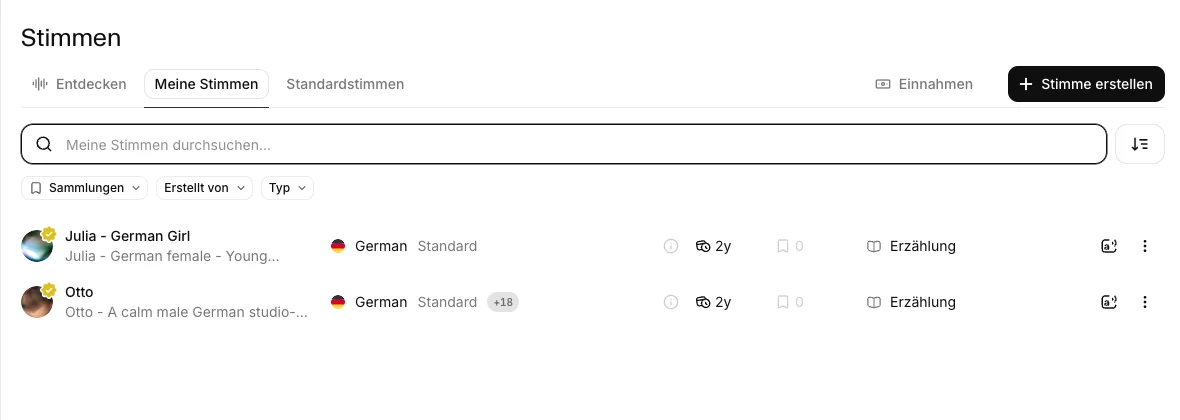
That's also where voice cloning shows why it goes further with ElevenLabs than with most alternatives. Creating a new voice gives you four methods to pick from, from a voice invented out of plain text to a professional clone built from 30 minutes of audio. How those four methods work in detail, how many voice slots your plan gives you, and how ElevenLabs enforces consent through a checkbox, I documented step by step in my ElevenLabs review.
What I do want to show you here is the result. For this comparison I built an Instant Voice Clone from about 22 seconds of audio, then generated the same German text once with the original voice and once with the fresh clone (German audio, since clone fidelity is what matters here, not the language):
Original: Liam, spoken with Eleven v3
Clone: the same text, generated with the freshly created Instant Voice Clone
For me, that's the proof that ElevenLabs leads on cloning. The clone picks up the original's pitch and speech rhythm almost seamlessly, from less than half a minute of source material.
How good the clones of the alternatives sound is something I can't play for you here. What I can compare is the effort. ElevenLabs gets by on about 10 seconds of audio, Lovo needs roughly a minute, WellSaid Labs only clones inside its curated process rather than on demand, and OpenAI TTS is the one tool in this comparison that doesn't clone at all.
How big the gap in feature scope really is shows best side by side:
| Feature | ElevenLabsOur pick | Lovo | Murf | Cartesia | Resemble | Speechify | WellSaid | Descript | OpenAI TTS |
|---|---|---|---|---|---|---|---|---|---|
| Text-to-speech | Yes | Yes | Yes | Yes | Yes | Yes | Yes | Yes | Yes |
| Voice cloning | Yes | Yes | Yes | Yes | Yes | Yes | Partial | Yes | No |
| Speech-to-text | Yes | Yes | Partial | Yes | Yes | Yes | No | Yes | No |
| AI musicGenerating music, not just adding it | Yes | No | No | No | No | No | No | No | No |
| Dubbing | Yes | Yes | Yes | Yes | Yes | Yes | No | Yes | No |
| Voice agents | Yes | No | Yes | Yes | Partial | Yes | No | No | No |
| Built-in editor | Yes | Yes | Yes | No | No | Yes | No | Yes | No |
| API | Yes | Yes | Yes | Yes | Yes | Yes | Yes | Yes | Yes |
| German voices | Yes | Yes | Yes | Yes | Yes | Yes | Yes | Yes | Yes |
As of August 2026. I looked these values up on the providers' own product and documentation pages. A cross means the provider doesn't list the feature as a product there, not that it's technically impossible. The Lovo column rests on search results from the official pages only, because lovo.ai blocks direct fetching.
Two things stand out to me here.
First, Murf, Cartesia, and Speechify are no longer pure point solutions. All three now do text-to-speech, voice cloning, dubbing, and voice agents. If you still have Murf filed away as a voiceover tool and Speechify as a read-aloud app, you're underrating both.
Second, exactly one gap stays open that none of the eight alternatives closes. In this field, only ElevenLabs generates AI music. Transcription, dubbing, and voice agents you can get elsewhere now, but the whole chain from one vendor only here. That's exactly what makes the difference in most cases.
And if you want a broader overview first, check out my comparison of the best AI voice generators.