I was a skeptic about AI voices for a long time.
Too robotic, too flat, too much like a train station announcement. Most of the tools I tried over the years sounded like a 2015 GPS unit. Fine for a demo, but nothing I'd seriously put on a YouTube channel or in an audiobook.
Then ElevenLabs kept coming up around me. Podcasters use it, dubbing studios talk about it, and in English-speaking AI circles it's been the reference point for years. So for this review I took another close look, not just clicking around the free plan, but using my own Creator plan, real scripts, and, where it mattered, real numbers I could check myself.
In this review I'll walk you through what I tested, where ElevenLabs genuinely impressed me, where it falls short, and who it's actually worth it for. And who, honestly, would be fine with something cheaper.
- ElevenLabs' flagship model is now called Eleven v3 and delivers the most natural AI voice quality I've heard so far, including audio tags like [whispers] and [laughs] that let you steer emotion right inside the script
- I tested nine features in my own account: text-to-speech with audio tags, a voice clone I built live, the Voice Changer, Scribe (92 languages), Music v2, Studio, sound effects, Dubbing v2, and an ElevenAgents support agent I built and ran a real test conversation with. All the speech samples share one fixed test script, which keeps them comparable
- It's not just text-to-speech but a full audio platform with transparent credit billing (roughly 1 credit per character on v3), which can also get expensive fast under heavy use
1. My verdict up front
So you don't have to read the whole thing if you're in a hurry: ElevenLabs is, in my opinion, the best AI tool for voices on the market right now.
My grade: 9.3 out of 10.
That number isn't a gut feeling. It's the weighted result of nine individual scores that I lay out with evidence in section 3. Without the stumble on Dubbing v2, the one tool that produced no result at all in my testing, it would be a 9.4.
The voice quality of Eleven v3 is at a level where I did a genuine double-take the first time I heard it. With the audio tags [whispers] and [laughs] I can steer emotion directly inside the script, something I haven't gotten from any other tool, and you can hear the difference yourself further down. On top of that, the biggest day-to-day win: I get text-to-speech, voice cloning, Scribe, a music generator, and dubbing in a single account, instead of paying for a separate tool for every task.
That said:
It's not the cheapest tool, and the credit billing can get expensive fast under heavy use, especially with the music generator if you set the length to "Auto" (more on that below, it caught me off guard too). The free plan also has no voice cloning, and Dubbing v2 gave me no result in two attempts. So if you only want to voice the odd blog post now and then, a leaner option usually does the job. But if you use voice seriously and regularly, there's barely any way around ElevenLabs right now.
Trying it costs you nothing, the free ElevenLabs plan is plenty for your first tests.
2. My test setup: what I actually did
For this review I didn't just poke around, I tested with real tasks on my own account.
My workspace is called "ElevenCreative" and runs on the Creator plan at $22/month, with the interface itself set to German. When I ran the first part of this test, I had 16,748 of 131,000 credits used, with the allowance renewing on August 19. The Creator plan's base allowance is 121,000 credits a month, so the extra roughly 10,000 credits look like a promo or a rollover.
To make the audio samples comparable at all, I locked myself into a single test script before I started. It runs through text-to-speech, through the voice clone, through the Voice Changer, and finally through transcription, word for word identical every time. The script is German on purpose, because I publish in German and because non-English output is where voices differ most, as section 4.1 shows:
Hallo, ich bin Finn. Gerade teste ich, wie natürlich diese KI-Stimme deutschen Text vorliest. Achte einmal auf die Betonung, das Sprechtempo und die kleinen Pausen zwischen den Sätzen.The conditions are fixed the same way, otherwise every sample would stand on its own.
- Model Eleven v3, except where I explicitly say otherwise. The Voice Changer and Studio run on Eleven Multilingual v2 at ElevenLabs.
- Voice Liam ("Energetic, Social Media Creator"), stability in the middle between Creative and Robust.
- Output as MP3 at 44.1 kHz and 128 kbps.
- Test window August 6 to August 10, 2026.
Specifically, I tested:
- Text-to-speech with Eleven v3, including audio tags, with real generations and traceable credit usage.
- The same script again on the older Eleven Multilingual v2 model and with a German voice, as a straight listening comparison.
- Voice cloning: I built an Instant Voice Clone live and put the original and the clone side by side.
- The Voice Changer, which turned my finished TTS voice into a completely different voice.
- Scribe (speech-to-text), measured against my own TTS sample, where I know the source text word for word.
- Music v2, including the song editor with sections, inpainting, and genre switching.
- Studio, the long-form environment for audiobooks, with one narrated test paragraph.
- The sound effects, with an English prompt for rain and distant thunder.
- Dubbing v2, twice, and neither attempt produced a finished dub.
- ElevenAgents: I built a real customer support agent and ran a test conversation with measured costs.
For anything you can actually listen to, I'm showing you real results from my account, playable right here. Dubbing v2 is the only one with nothing to play, and I spell out why in section 9.
3. My test verdict in numbers
Before I walk through the tools one by one, here's my verdict at a glance. Every row names what I tested with and where the evidence sits in this article, so you can recheck my scores instead of taking my word for them.
So how do I get to an overall score from that?
I weight by how much each part matters day to day. Text-to-speech counts for 30% and voice cloning for 20%, because that's the core of the product. Scribe gets 15%, ElevenAgents and Music v2 10% each, Voice Changer and Studio 5% each, and the last 5% is split between sound effects and dubbing. That works out to 9.275, so 9.3 after rounding.
Without Dubbing v2 it would be a 9.4. I'm leaving the outlier in the math anyway, because a tool that fails twice belongs in the score, not in a footnote.
4. Text-to-speech: Eleven v3 and audio tags
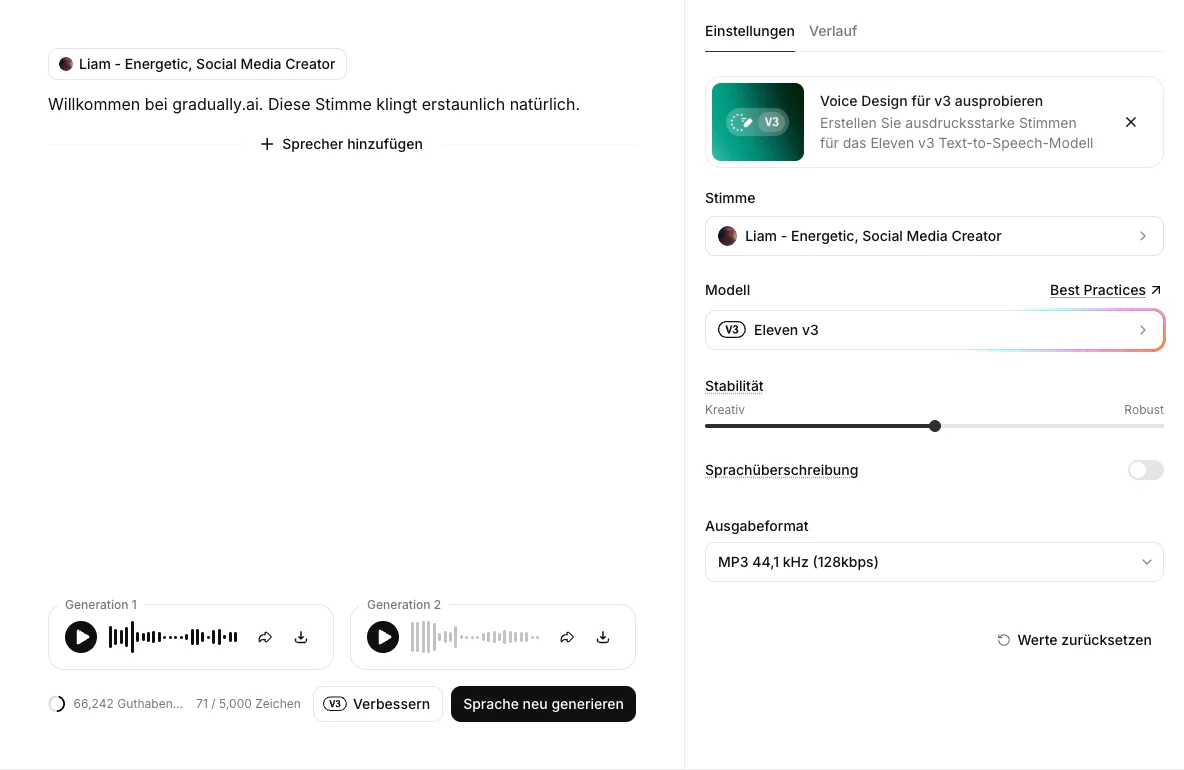
The core of ElevenLabs is now the Eleven v3 voice model. It covers 70+ languages, and by default it outputs MP3 files at 44.1 kHz and 128 kbps, with WAV and other formats selectable. Each generation allows up to 5,000 characters with v3, and you automatically get 2 variants to choose from.
For the voice, I used "Liam, Energetic, Social Media Creator," freely selectable from the library, plus a stability slider between Creative and Robust.
First, I generated a plain read of my fixed test script from section 2, with no frills and not a single control instruction.
Audio sample: the fixed test script with Eleven v3 and the voice Liam, no audio tags (German audio)
To back this up, here's the credit math, because vague numbers annoy me too. I counted three generations. My test script is 184 characters, and afterward my balance was exactly 184 credits lower. A second run of 148 characters cost exactly 148 credits, and a third of 182 characters exactly 182. So on Eleven v3, one character costs you almost exactly one credit, no discount and no markup. The full measurement series across every feature is further down in section 15.
Now for the part that genuinely impressed me.
Audio tags are small markers you write right into your script, and the voice acts on them. With [whispers] it whispers, with [laughs] it laughs. The editor even highlights both tags in color inside the text, so you can see what it recognized before you generate anything. Since my fixed test script deliberately has no tags in it, I used a second, short script for this:
"[flüstert] Ich verrate dir ein Geheimnis. [lacht] Keine Sorge, nichts Schlimmes. Diese Stimme wurde komplett von einer KI erzeugt." In English: "I'll tell you a secret. Don't worry, nothing bad. This voice was generated entirely by an AI."
Worth noting for anyone working outside English: the tags work in German too. I wrote [flüstert] and [lacht] rather than [whispers] and [laughs], and the editor recognized and highlighted both.
Audio sample: the tag script with [flüstert] and [lacht], listen for the emotional difference (German audio)
The difference is obvious the moment you listen. The first sample reads the text, the second one performs it. No other text-to-speech tool I know offers this.
4.1 English voice versus German voice, same German script
Eleven v3 covers 70+ languages. That number tells you nothing about how native a single voice sounds, and that's exactly where non-English projects fall over. Liam is an English voice speaking German, Otto is a German studio voice. Both get the same script and the same model here.
English voice Liam on Eleven v3, fixed test script (11.8 seconds)
German voice Otto on Eleven v3, identical script (11.2 seconds)
On first listen both sound good, and that's the trap. The difference sits in how individual words come out. You hear it most clearly on "vorliest," which Liam slurs into something closer to "vollließt." Otto says the same word cleanly. There's a pace difference too: Liam takes 11.8 seconds for the identical text, Otto only 11.2.
So for content in a given language, pick a voice native to it, even when an English voice "kind of works" in your test. The effort is the same, the credits are the same, and the difference is obvious to exactly the listeners you're producing for.
4.2 Eleven v3 versus Eleven Multilingual v2
"The most natural AI voice I've heard" is a worthless claim as long as you only get to hear one recording. So I had Otto read my test script a second time, this time on the older Eleven Multilingual v2 model. Same voice, same 184 characters, only a different model underneath.
Otto on Eleven v3, fixed test script (11.2 seconds)
Otto on Eleven Multilingual v2, identical script (11.5 seconds)
My takeaway is more sobering than the version numbers suggest. Both models deliver the sentence cleanly and without a single wobble, with v3 a touch quicker (11.2 versus 11.5 seconds). The real difference isn't the sound of a plain sentence, it's what you get to control.
- Eleven v3: 70+ languages, audio tags, two variants per generation, but only a single slider for stability.
- Eleven Multilingual v2: 29 languages, labeled "studio quality" by ElevenLabs itself, only one generation per run, but finer sliders for speed, stability, similarity, style exaggeration, and speaker boost.
- Flash v2.5: 32 languages, tuned for ultra-low latency and built for real-time conversation rather than produced audio.
And one detail in the editor argues against writing v2 off as "the old model."
For the best consistency with professional voice clones, ElevenLabs explicitly recommends Multilingual v2 over v3. Fittingly, the Voice Changer and Studio run on v2 as well. So if you produce regularly with a cloned narrator, the supposedly older model may serve you better.
Both generations cost me exactly the same, by the way: 184 credits for 184 characters. In the text-to-speech editor, v2 is not the budget option, so choosing between models is purely a question of quality and control.
5. Voice cloning: Instant vs Professional
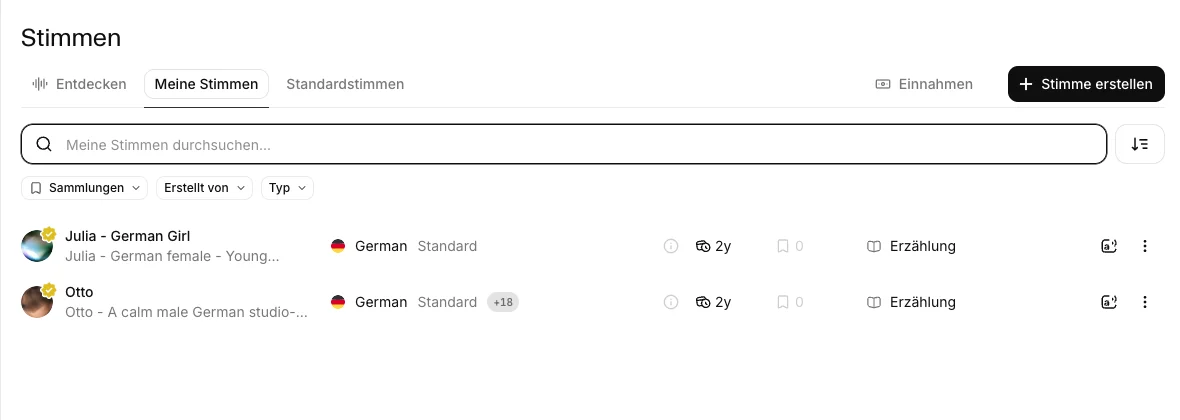
Voice cloning has changed quite a bit since I last took a close look. Under "Create voice," ElevenLabs now offers four routes: Voice Design (you describe a voice in text and get it in under a minute), Instant Voice Cloning, Professional Voice Cloning, and voice remixing.
The difference between Instant and Professional is the one that matters most for readers.
The Instant Voice Clone (IVC) needs only around 10 seconds of audio, and processing takes about 2 minutes afterward. It's included in the cheapest paid plan from $6 and is enough for plenty of quick projects. The Professional Voice Clone (PVC) needs a lot more, at least 30 minutes of clean recordings, and processing takes around 5 minutes. In exchange, the clone is then almost indistinguishable from the original. PVC only becomes available from the Creator plan at $22, and even there my account only gets exactly one reserved slot for it. Higher plans give you more, three on the Scale plan, for example.
On the free plan, by the way, there's no voice cloning at all, neither Instant nor Professional. My Creator account showed 0 of 30 voice slots used at the time, which is the overall capacity for your own and cloned voices on this plan, separate from the one dedicated PVC slot.
This time I didn't just describe the Instant Voice Clone, I built one live. I clicked "Create voice" under the voices, uploaded two speech samples totaling around 22 seconds, with the "Remove background noise" option on by default. After roughly two minutes of processing, my clone was ready, with a message that my voice was now available to use across the whole product.
There was one step ElevenLabs would not let me skip:
Before I could save the clone, I had to explicitly confirm with a checkbox that I had all the rights and permissions needed to upload and clone these voice samples, complete with a pointer to the terms of use, the prohibited-content policy, and privacy. So the exact consent rule I described above is something the product enforces itself at this point. Cloning someone else's voice without permission isn't just against the rules here, it's technically blocked.
And now the actual test:
How close does a two-minute clone get to the original? The fixed script pays off again here, because both recordings speak the exact same 184 characters. Above you get the original voice Liam, directly below it my freshly built Instant clone.
Original: the ElevenLabs voice Liam with the fixed test script (German audio)
Instant Voice Clone: built from my uploaded samples, identical script (German audio)
My verdict: for two minutes of effort and around 22 seconds of source material, the resemblance is impressive. The clone nails the timbre and the way the voice carries, and for quick projects I'd use it without hesitation. It isn't a perfect match for the original, and that last gap is exactly why the Professional Voice Clone, with its 30 minutes of material, exists in the first place.
6. Voice Changer: turning my voice into another
The Voice Changer does something different from cloning: it takes a finished recording and lays it onto another voice, without regenerating the content. ElevenLabs calls it speech-to-speech.
One detail plenty of people miss:
The Voice Changer doesn't run on the flagship Eleven v3, it still runs on the older Eleven Multilingual v2 model. That's stated right in the interface. You upload audio up to 50 MB or record directly, and you set stability, similarity, style exaggeration, background-noise removal, and speaker boost with sliders.
For the test, I took my finished TTS sample with the voice Liam, the same plain recording from further up, and turned it into the voice "Julia" (German Girl). The words stay identical, only the voice changes.
Audio sample: my Liam TTS clip, run through the Voice Changer into the voice Julia (Eleven Multilingual v2). The audio is in German, the point is the voice swap.
It cost me 197 credits for 12 seconds of audio, so roughly 985 credits per minute. That's clearly pricier per second than plain text-to-speech, but reasonable for what's happening. The Voice Changer is handy whenever you already have a recording, your own speaking, an interview, or a finished take, and you only want to swap the voice on top of it instead of re-recording or regenerating everything.
7. Scribe: speech-to-text in 92 languages
ElevenLabs doesn't just turn text into voice, it works the other way too. The tool for that is called Scribe Realtime v2.
In its live banner, ElevenLabs bills Scribe as "lightning-fast transcription with unmatched accuracy in 92 languages" and calls it the "industry-leading ASR model." Big words, but I can confirm the language count: 92 languages are genuinely available.
This time I measured Scribe myself, using a case where I know the truth in advance.
I had it transcribe my own TTS sample from further up. The source text is fixed word for word, 28 words, so every deviation can be pinned down exactly. Scribe detected the language correctly as German on its own.
Hallo, ich bin Finn. Grade(Gerade) teste ich, wie natürlich diese KI-Stimme deutschen Text vorliest. 8(Achte) einmal auf die Betonung, das Sprechtempo und die kleinen Pausen zwischen den Sätzen.Two deviations across 28 words, so roughly 93% word accuracy. Both are instructive. "Gerade" became "Grade," which comes down to the loose delivery of the AI voice and is genuinely ambiguous in spoken German. "Achte" became the digit "8," and that one is a true homophone error, because "achte" and "acht" sound the same.
The hard test lives elsewhere. I already put ElevenLabs through my detailed comparison of AI transcription software against five other tools, recorded on an old MacBook's built-in microphone under deliberately imperfect conditions. There it hit 98.11% character accuracy and 90.26% word accuracy, taking first place out of six tools.
And here's a point the marketing skips.
For my twelve-second clip, the batch upload took over two minutes. Nothing about that felt "lightning fast." The fast path is the Scribe Realtime v2 streaming route, not the file upload. So if you plan to push larger batches through it, budget for the wait.
What's practical for me is that I don't need a separate tool for transcription, I stay in the same account. If you transcribe a lot, though, it's worth looking at specialized providers like Sonix or Amberscript, which are built for exactly that job.
8. Music v2: the music generator
Since late May 2026, there's also a music generator called Music v2, currently the second model after an earlier version that's still visible in my generation history.
Here's the credit math again. Music v2 costs 900 credits per minute, per variant, and ElevenLabs automatically generates 2 variants per generation. That's 1,800 credits per minute of music. When I set the length to "Auto," the tool built me two variants of 2:00 and 2:30 without asking. Measured against the balance before and after, that single generation cost 4,115 credits.
For lyrics, you can choose between "Auto" (auto-lyrics) or your own text. ElevenLabs usually detects the genre automatically from your prompt, in my tests that meant hip-hop, electronic, and ambient. For downloads you get MP3, MP4, WAV, and an extended format.
Audio sample: 30 seconds from a lo-fi track I generated with Music v2
What impressed me most was the song editor. You work with a timeline of sections there, Intro, Verse, Bridge, and Outro. Each section has its own style tags and its own tempo, in my test for example "relaxed lo-fi hip-hop groove," "dusty snare," and 82 BPM. This is exactly where inpainting lives, you can regenerate a single section without touching the rest of the song, or give it a different genre entirely through new style tags.
How far that genre switch actually carries is something I measured separately.
It reliably lands at tag level, so the selected section really does get new style and tempo tags while the neighboring sections stay untouched. Sonically, though, the switch stayed much closer to the original than the new tags promise. The measurements for that are in my Music guide, linked just below.
Every such regeneration costs another 900 credits per minute and variant, so you use it deliberately rather than at random. I looked closely at the interface and the full workflow, and for a still-young music feature, it feels surprisingly polished.
I wrote up exactly how inpainting, genre switching, and the song editor work, plus how Music v2 stacks up against Suno, in a dedicated ElevenLabs Music guide.
9. Dubbing v2: automatic video translation
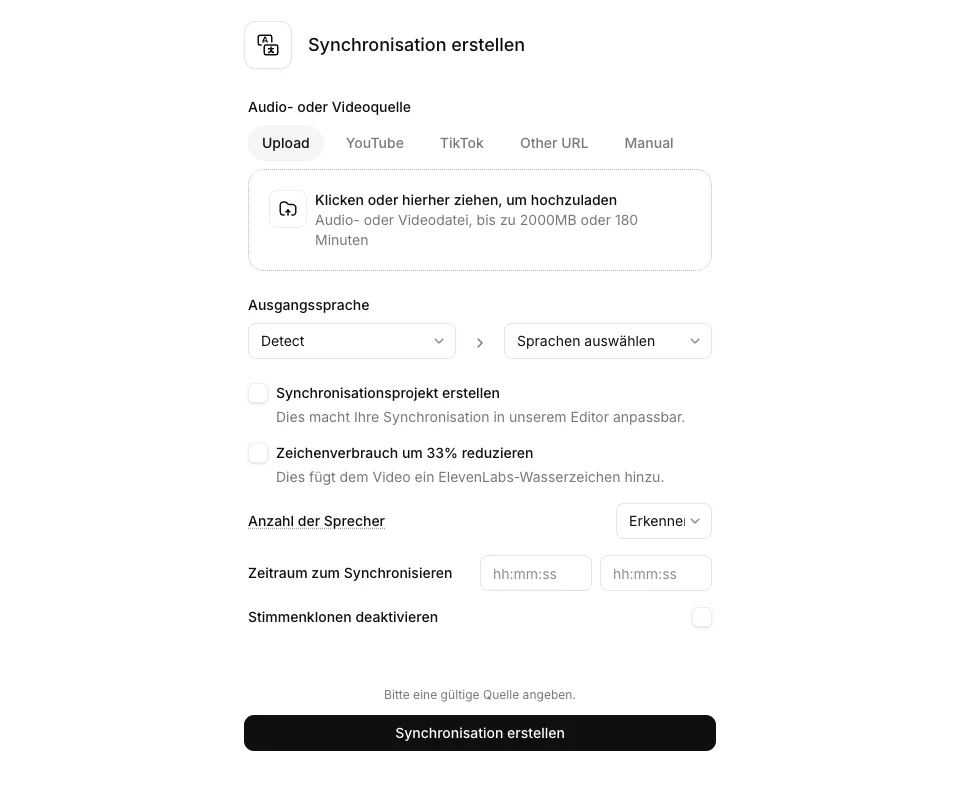
For video translation and dubbing, ElevenLabs has its own tool, currently labeled "Dubbing v2 (Alpha)."
In the intro modal, ElevenLabs makes three promises for Dubbing v2:
- The emotion and expression of the original speaker are preserved.
- The wording is adapted so the translation sounds natural in 92 languages.
- Voice cloning and syncing happen automatically.
On the upload screen, you either upload a file up to 10 MB or paste a URL directly. After that, you pick your target languages, and there's an "Advanced" section with additional settings.
And this is where my test ends, because Dubbing v2 is the only tool in the entire run that gave me no result at all.
On the first attempt I went through the file upload, with exactly the audio file I had already pushed through the Voice Changer and through Scribe. Both had accepted it without complaint. In Dubbing v2 the detected duration stayed stuck on "--," the spinner kept turning, and the generation could not be started.
On the second attempt a few days later I took the URL route and pasted a sample URL from gradually.ai. That failed too, this time with the message "Media from this URL could not be loaded." I only half blame ElevenLabs for that one, since my own site's bot protection likely blocked the fetch.
That leaves the first failure, and it is unambiguous. Same file, same account, two other tools, two clean results. In Dubbing v2, nothing.
From an earlier test, there's still a dubbing sample sitting in my account, an excerpt from Sebastian Fitzek's "Elternabend," though that one used the previous model, Dubbing v1. So the fact that ElevenLabs labels the new version as alpha lines up pretty precisely with what I ran into.
10. ElevenAgents: voice bots
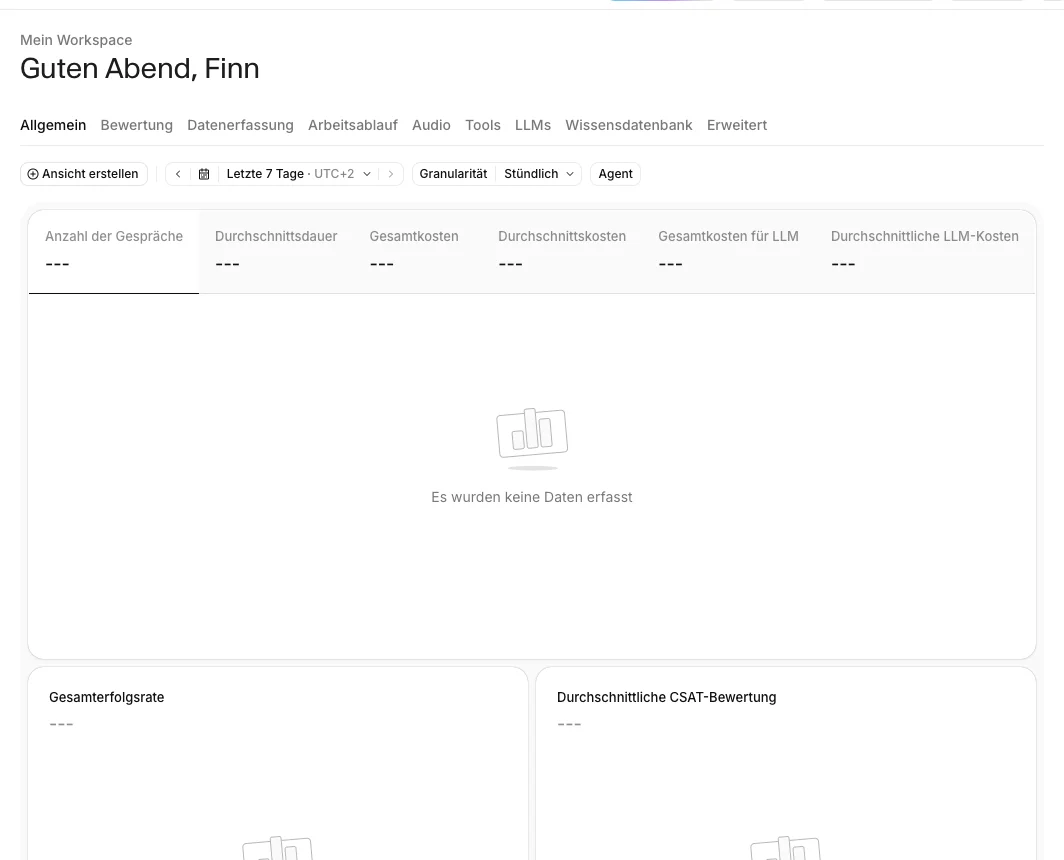
ElevenLabs also offers ElevenAgents, a builder for AI voice agents, bots that talk on the phone or in chat.
ElevenAgents is a big topic in its own right. I looked through the dashboard, and even there it's clear how extensive the builder is: phone numbers, WhatsApp, a knowledge base, tools, and the LLM configuration all live in one interface.
This time I didn't stop at looking, I built an agent and tested it.
There are two ways to do it: a five-step wizard (template, industry, use case, tools, create) or ready-made quick-start templates like Customer Support, Language Practice Tutor, or Front Desk Receptionist. I started with the "Customer Support" template. It doesn't come empty, but with a complete system prompt (personality "Jamie, a calm, knowledgeable support engineer," plus environment and tone) and a whole tools layer: your own tools like Zendesk or Salesforce via API key, and system tools like end call, detect language, transfer to a human agent, or update status.
One detail I liked as a developer:
When you publish, ElevenAgents shows a diff-review dialog, published versus current version, almost like Git, with a commit message. Version control for voice agents, cleanly done.
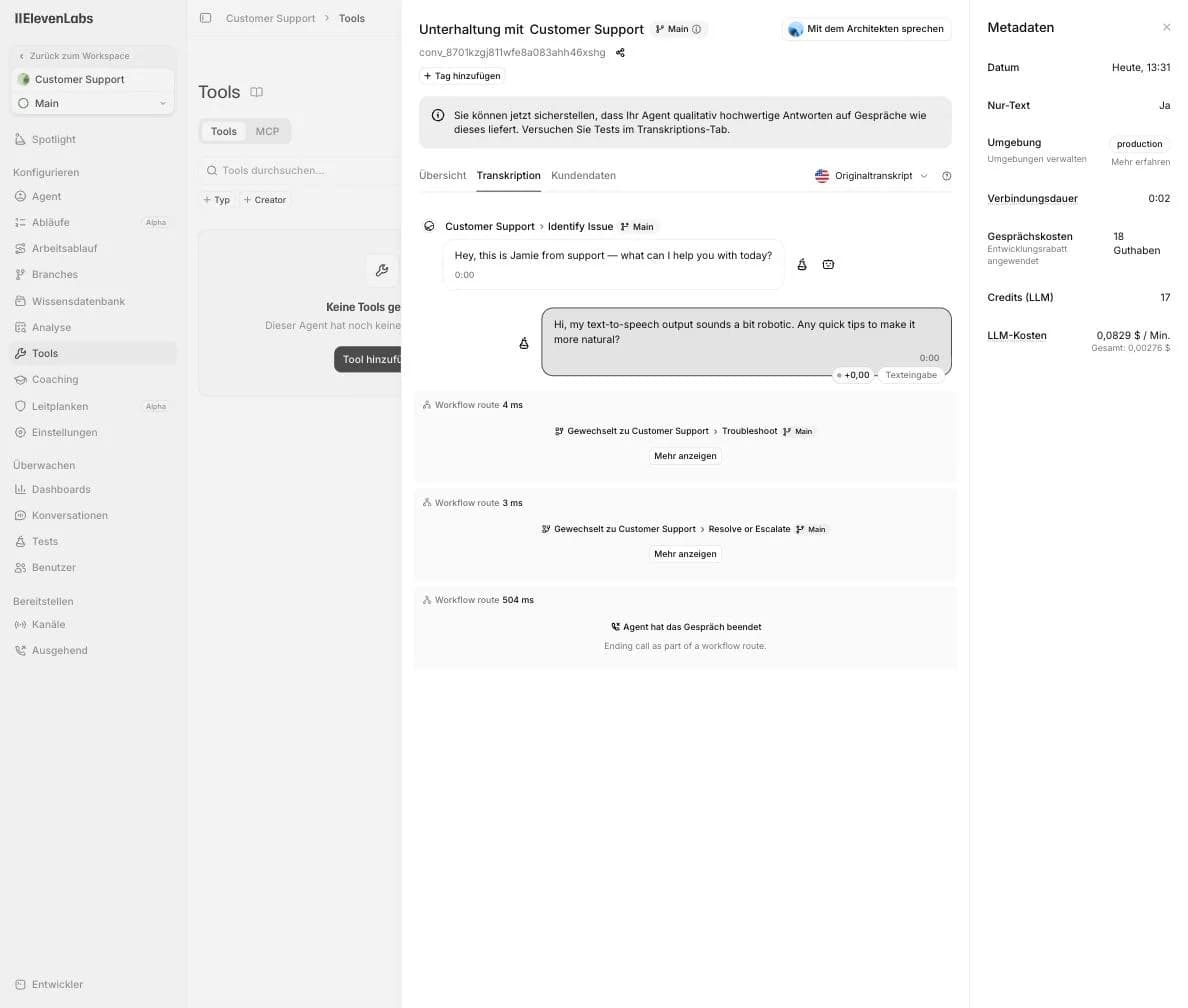
Then the actual test conversation. Through the text widget, the agent greeted me ("Hey, this is Jamie from support, what can I help you with today?"), took my question, and ran through a multi-step workflow: Identify Issue, then Troubleshoot, then Resolve or Escalate. So the "Customer Support" template isn't a simple prompt agent, it's a workflow agent with real branches.
And yes, I have to flag one catch:
In pure text test mode, the workflow cut off the final text answer at the end, because it jumped to "end call" as part of a workflow route. This agent is clearly built for voice, not for chat, and ElevenLabs' automatic conversation summary named exactly that itself.
What did impress me was the analysis afterward. Every conversation gets its own detail page with an AI-generated summary, a conversation status (mine was "Successful"), a sentiment analysis (neutral, no frustration), and the full word-level transcript with timestamps and the workflow routes it ran through. The costs are there to the cent too: 18 credits for the conversation (with a developer discount), 17 of them for the language model, billed at $0.0829 per minute. For two seconds of connection time, that comes out to a total of $0.00276, a fraction of a cent.
One point you should know before you picture a phone bot:
ElevenLabs doesn't sell its own phone numbers. You can only import a number from Twilio, from a SIP trunk, or from Exotel, each with an external account and credentials. So ElevenAgents is the voice and logic layer, and you bring the actual telephony from another provider. On top of that, the channels also include WhatsApp and outbound calls in batches.
For a first real test, ElevenAgents won me over: the templates take a lot of work off your hands, the analysis is first class, and the workflow logic is more than a simple chat prompt. But if you want to get serious with it, you should test the agent in voice mode, not chat, and plan the telephony connection in from the start.
11. Studio: long form for audiobooks and long texts
Studio is the long-form environment for projects like audiobooks. You create an audio project, work in chapters and paragraphs, and assign each paragraph its own voice. I voiced a test paragraph with the German studio voice "Otto," which runs on Eleven Multilingual v2 there and cost about one credit per character, so 281 credits for my short paragraph. Each paragraph has its own AI tools like improve text, Voice Changer, or remove background noise. Pure audiobooks have even moved into their own area outside of Studio.
12. Sound effects
I also gave the sound effects a quick spin. From an English prompt like "gentle rain on a window with distant thunder," ElevenLabs generates four short variants at once, which you then refine through suggestions like "rain intensity" or "thunder detail."
The four clips ran about one second each in my test, too short to embed as a sample here. The cost is also the one number in this entire review that I estimated rather than measured against the balance, at roughly 17 credits for the set of four variants.
13. The strengths, from my point of view
After this review, these are the points where ElevenLabs clearly comes out ahead for me:
- Quality and naturalness: This is the most important one. Eleven v3 sounds closer to a real person than anything else I've tested. With emotional or narrative scripts, the difference is obvious.
- Audio tags as a true differentiator: Writing [whispers] and [laughs] directly into the script and hearing exactly that in the result doesn't exist anywhere else like this. It's not just a nice extra, it's the reason ElevenLabs sits so far ahead for demanding voice projects.
- One platform instead of many subscriptions: Text-to-speech, Scribe, voice cloning, Music v2, dubbing, and ElevenAgents in one account. That's the underrated day-to-day advantage for me, because I don't have to juggle multiple tools and multiple invoices.
- Traceable credit billing: On Eleven v3, one character costs almost exactly one credit, and I verified that down to the exact digit in this test. No hidden rounding, no surprise on the invoice.
14. The weaknesses
No tool is perfect, and I wouldn't be doing my job if I only gushed. These are the points you should know about:
- No voice cloning on the free plan: You can use voices for free, but you can't clone your own. Instant Voice Cloning only starts at Starter, Professional Voice Cloning only at Creator.
- Music v2 on "Auto" eats credits fast: A single generation cost me 4,115 credits, roughly 3.4% of a Creator monthly allowance for one attempt. If you're testing, cap the length manually.
- The price can climb with heavy use: ElevenLabs bills by credits. As long as you voice things occasionally, the cheap plans cover you fine. But if you produce long scripts or full audiobooks daily, you burn through credits quickly and end up on the higher plans.
- Dubbing v2 did not work for me at all: Two attempts, no finished dub. Once the file upload refused to validate, once the URL fetch failed. The alpha label is apparently meant literally.
- USD billing plus VAT for EU buyers: The plans are listed in US dollars. As a buyer from the EU, you pay the listed USD price plus 19% VAT, so $22 for Creator becomes roughly $26 on the invoice.
- Higher latency with v3 for real time: Eleven v3 gives the best quality but takes a bit longer to generate. For pre-produced content that doesn't matter, but for a live voice bot, the latency is something you have to plan around.
- Most natural voice quality on the market (Eleven v3), especially for emotional scripts
- Audio tags like [whispers] and [laughs] for real emotion right inside the script
- Full audio platform: TTS, voice cloning, Scribe (92 languages), Music v2, dubbing, and ElevenAgents in one account
- Traceable credit billing, roughly 1 credit per character on v3
- Free plan to try it out, paid entry from $6/month
- Commercial license on every paid plan
15. Pricing and plans
Before we get to the plans, here's the number that actually matters day to day.
I noted the balance before and after every single generation, and that's how this table came about, measured in the upgraded Scale account. I deliberately did not force the units into a common shape, because ElevenLabs bills per character, per minute, or per call minute depending on the feature.
Two rows are worth comparing directly. A complete new track cost me 4,115 credits, while regenerating a single section in the song editor cost only 1,350. Fixing things in the editor instead of rerolling the whole track runs you about a third of the price.
What ElevenLabs officially charges per feature and model is in my ElevenLabs pricing guide. The table above shows what actually came off the balance.
ElevenLabs has a free version and several paid plans. Here are the most important ones at a glance, with the numbers from my own account and the pricing page.
Extra minutes beyond your allowance cost between $0.36 (Free) and $0.17 (Pro and Scale) per minute, the cheaper the plan, the pricier the extra minute gets. On Creator, the extra minute costs $0.18, and if you run out of credits there, you can top up with pay-as-you-go.
Studio projects also differ by plan: 20 on Starter, 1,000 on Creator, 3,000 on Pro, and 9,000 on Scale. For very large teams there's also a Business plan. According to the pricing page, it runs $990 a month with 6,000,000 credits, so roughly 6,000 free minutes. Those figures come from the official pricing page, not my own account, since the Business plan sits above my Creator plan.
Pay annually instead of monthly, and ElevenLabs gives you two months free, so you effectively pay for 10 months instead of 12. As an EU buyer, VAT at 19% always gets added on top, so the $22 Creator plan comes out to roughly $26 on the invoice.
For a more detailed breakdown of all seven plans, including the Business plan and the VAT math for EU buyers, check out my dedicated ElevenLabs pricing guide.
16. When ElevenLabs is worth it, and when it isn't
The short answer is that it depends. But I don't like leaving you with a non-answer like that, so here's my clear take.
16.1 Who ElevenLabs is worth it for
ElevenLabs is worth it for you if you use voice seriously and regularly. Concretely, that means:
- You produce voice-overs for YouTube videos or explainer films and want them to sound professional, with real emphasis instead of flat narration.
- You create audiobooks or narrate longer texts and need a voice that carries emotion.
- You run a podcast and want to produce intros, trailers, or full episodes with AI voices, or transcribe interviews with Scribe.
- You want to clone your own voice and reuse it again and again without re-recording every time.
- You publish in multiple languages and need clean voices across many languages from one place.
In all of these cases, the mix of quality, audio tags, and platform depth is worth the price.
16.2 Who would be fine with something cheaper
Don't get me wrong:
ElevenLabs is excellent, but not everyone needs that. A leaner, cheaper option is probably enough for you if:
- you only want to voice the occasional blog post for listening.
- a solid but not perfect voice is enough because it's purely informational.
- you mostly transcribe and barely generate speech, in which case specialized transcription tools are often the better choice.
- you're on a very tight budget and the USD price plus VAT weighs on you.
In those cases, it's worth a look at the ElevenLabs alternatives, where I go into cheaper and specialized tools in detail.
17. My final word
I went into this review as a skeptic and came out a user.
ElevenLabs won me over because it delivers exactly what I'd long missed in AI voices, namely naturalness, emotion, and a depth that goes beyond plain narration. The audio tags [whispers] and [laughs] are the feature that makes the difference for me, and the platform genuinely saves me time day to day because I no longer switch between multiple tools.
Is it the cheapest tool? No. Is it worth it for everyone? Also no, and with Music v2 you need to watch the length setting, or your balance disappears faster than you'd expect, I learned that on my own account. But for anyone who uses voice seriously, ElevenLabs is the first port of call right now. And you can try it for free before you spend a single cent.
If you want to test it yourself, you can head straight to ElevenLabs here and start with the free plan.